
 Korean
- CompanyCompany
- TechnologyTechnology
- Motorized StageMotorized Stage
- Manual StageManual Stage
- Customer ServiceCustomer Service
- Arch-ServoArch-Servo
- SpecificationSpecification
- MaterialMaterial
- BearingBearing
- Drive SystemDrive System
- Motion ControlMotion Control

 home > Technology > Arch-Servo > Full Closed-Loop Driver
- Absolute EncoderAbsolute Encoder
- Full Closed-Loop DriverFull Closed-Loop Driver
- 6DOF Active Align Stages6DOF Active Align Stages
|
FIELD-ORIENTED CONTROL / ETHERCAT
HYBRID FOC
|
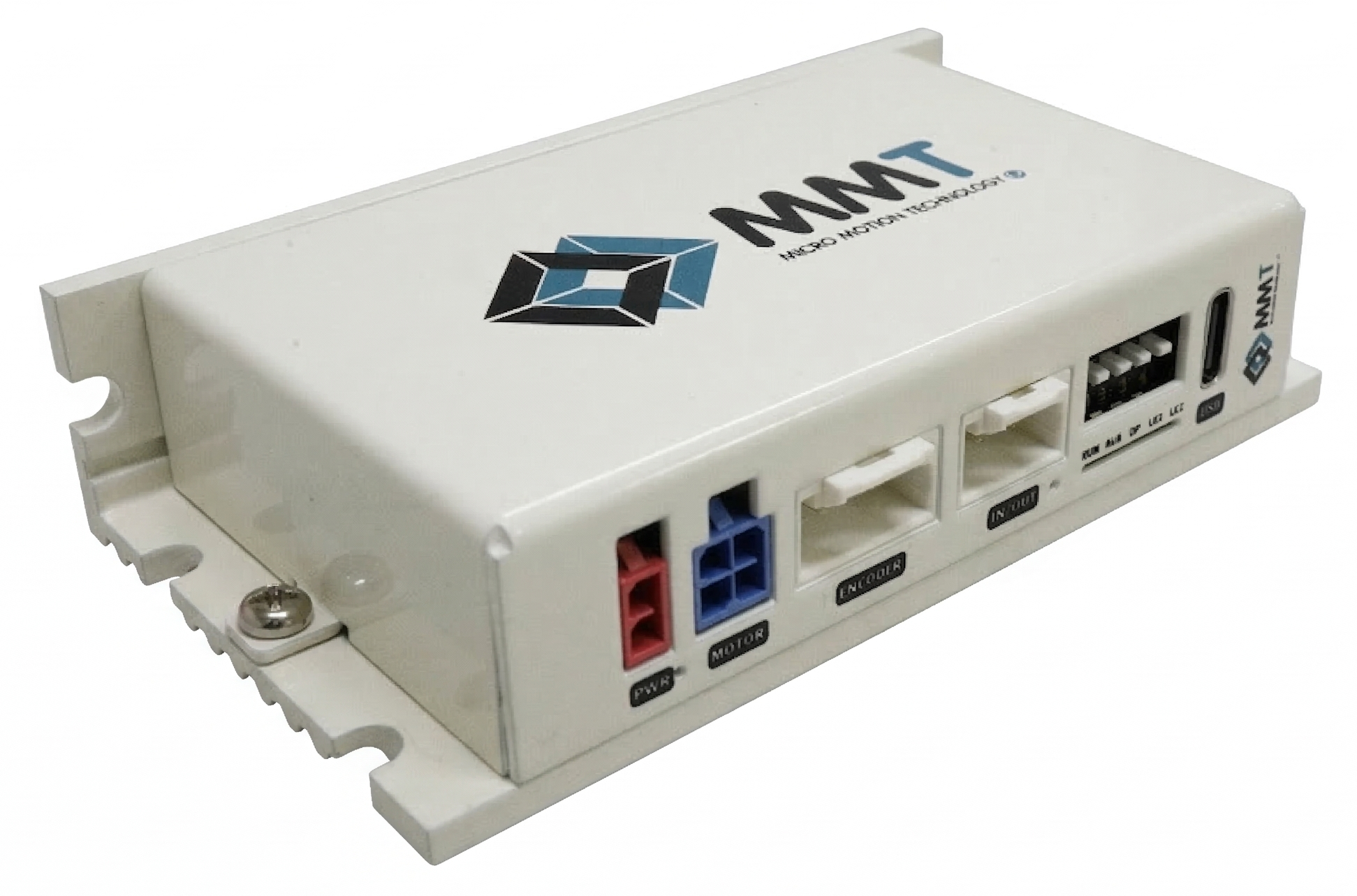
Contact us for the dedicated GUI, EtherCAT ESI file, API libraries, and sample programs.
Stepper Motor Stiffness Meets Precision Servo Control
Conventional 5-phase open-loop drives are limited by thermal drift from continuous current and reliance on the motor step angle.
High-resolution encoder feedback and FOC combine with 2-phase steppers for low-speed and holding stiffness, or BLDC motors for high-speed motion, to deliver precise, stable control.
Without position feedback, continuous rated current and mechanical constraints limit performance in nanometer-scale positioning.
- Limited Positioning Accuracy: Position depends on the motor step angle; torque ripple limits positioning linearity during microstepping
- Loss of Synchronism: Disturbances or rapid acceleration can cause undetected loss of rotor synchronism and position
- Continuous Heat Generation: Rated current at standstill or light load generates heat and causes thermal drift in the stage
- High-Speed Torque Loss: Rising back EMF reduces torque at higher speeds, limiting rapid long-travel moves and cycle-time reduction
Real-time encoder feedback tracks rotor angle for sinusoidal vector control, providing high holding stiffness and nanometer-scale positioning resolution.
- Encoder-Based Position Control: High-resolution encoder feedback defines positioning resolution beyond the motor’s nominal step angle
- Synchronism & Position Tracking: Real-time load-angle compensation prevents loss of synchronism within rated limits; absolute position remains tracked during overload
- Reduced Motor Heating: Current is adjusted to load demand, minimizing heat generation and thermal drift
- Wide Operating Speed Range: SVPWM-based vector control and dedicated BLDC models support both low-speed precision positioning and high-speed travel
FOC Technology & Integrated Control Tools
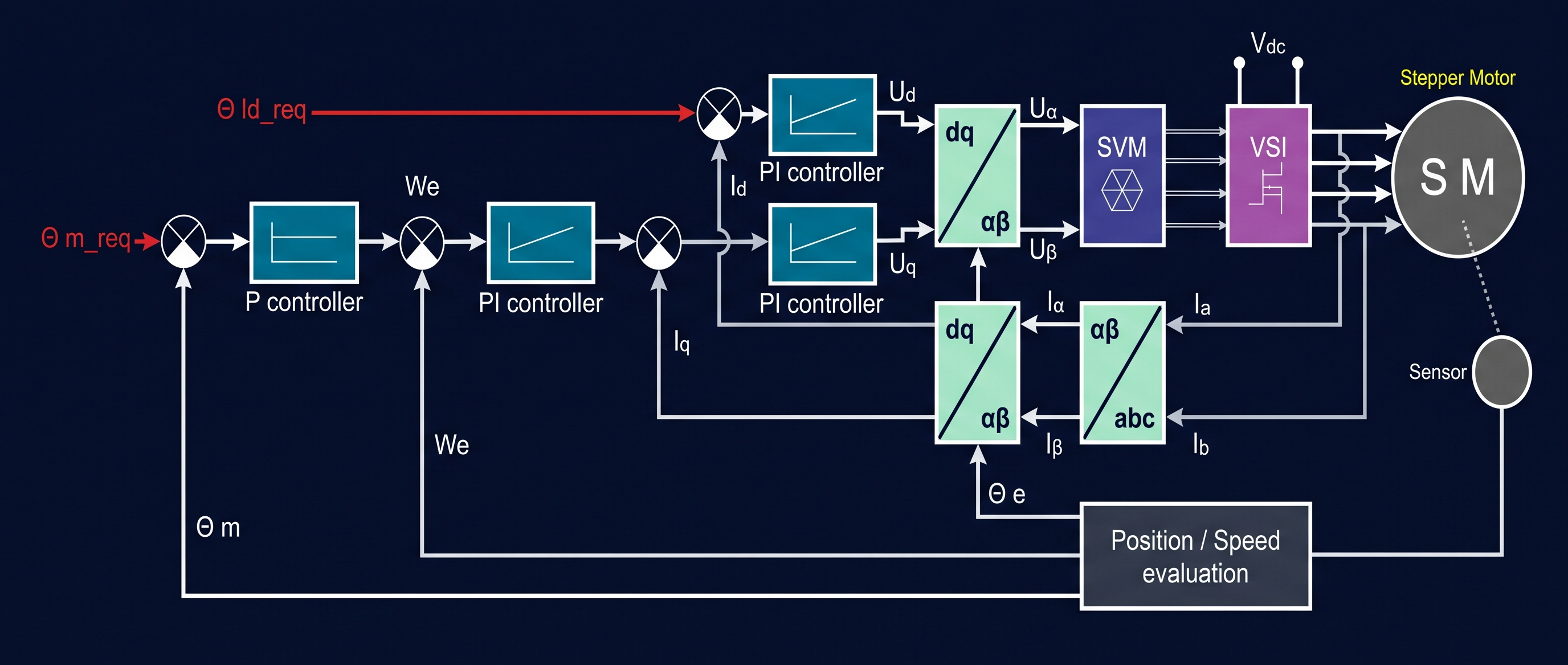
Cascaded position (P), velocity (PI), and current (PI) loops with dq coordinate transformation independently control flux-producing current (Id) and torque-producing current (Iq).
Space vector PWM (SVPWM) suppresses low-speed resonance and torque ripple while maximizing voltage utilization and output torque.
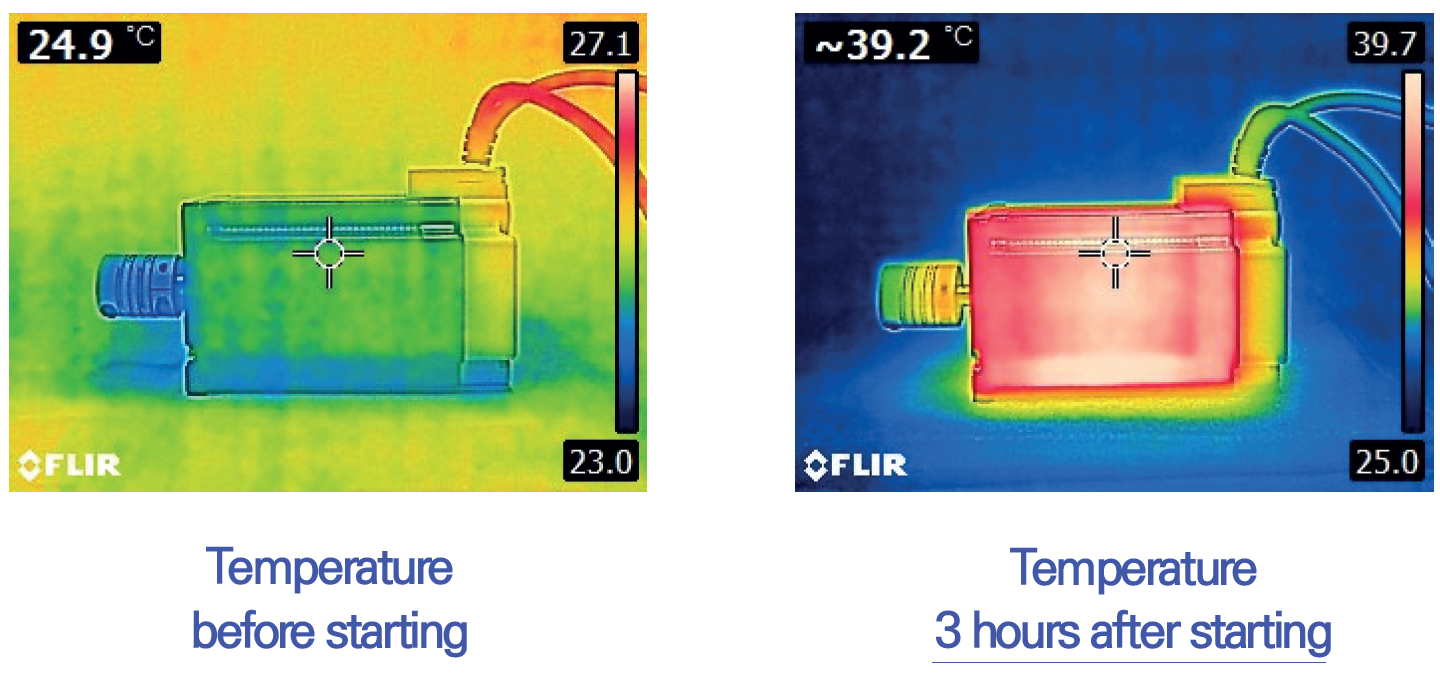
With load-adaptive current control, the measured surface temperature remained below approximately 40°C after 3 hours of continuous operation.
Reduced heat transfer to the stage helps limit thermal drift during extended operation.
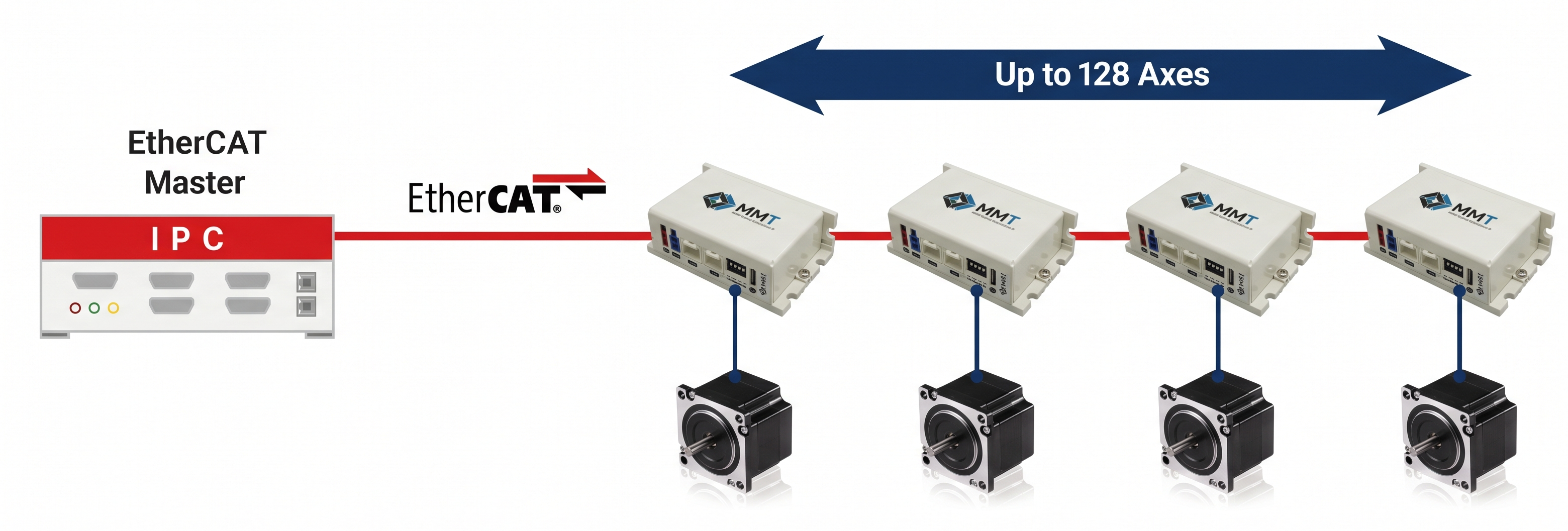
The standard EtherCAT protocol supports daisy-chain connectivity for up to 128 axes from a single IPC master.
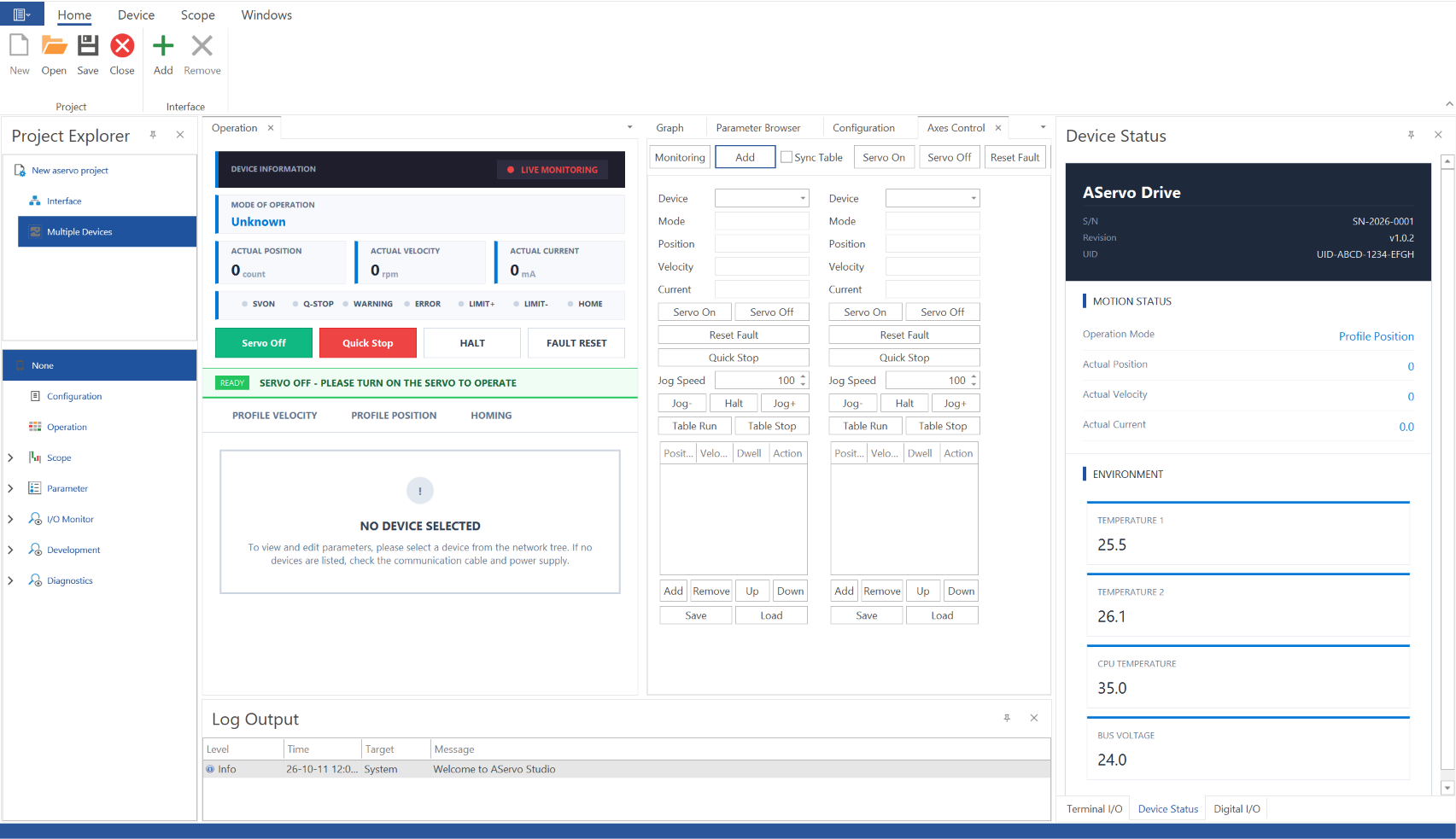
Dedicated software connects directly to a PC via CAN, USB, or RS232 for setup and testing without a host motion controller.
- Multi-Axis & Scope: Multi-axis sequencing (Sync Table), real-time waveform analysis, and gain tuning
- Live Diagnostics: Real-time monitoring of internal temperature, voltage, current, I/O, and alarms
Nanometer-Scale Step Response Verification
Encoder resolution differs from the stage’s actual minimum incremental motion. Without fine current control and sufficient mechanical stiffness, friction can cause stick-slip motion rather than smooth incremental displacement.
The data below use a Renishaw XL-80 laser interferometer to verify that 50 nm and 25 nm step commands produce the corresponding physical displacement.
In silicon photonics (SiPh), fiber array units (FAUs), and lens alignment, deviations of tens of nanometers can significantly reduce optical coupling efficiency. To locate the minimum-loss position during active alignment, repeatability and accuracy alone are insufficient: fine motion resolution is critical.
Verified 25 nm / 50 nm motion increments provide precise positioning to locate the minimum insertion-loss position.
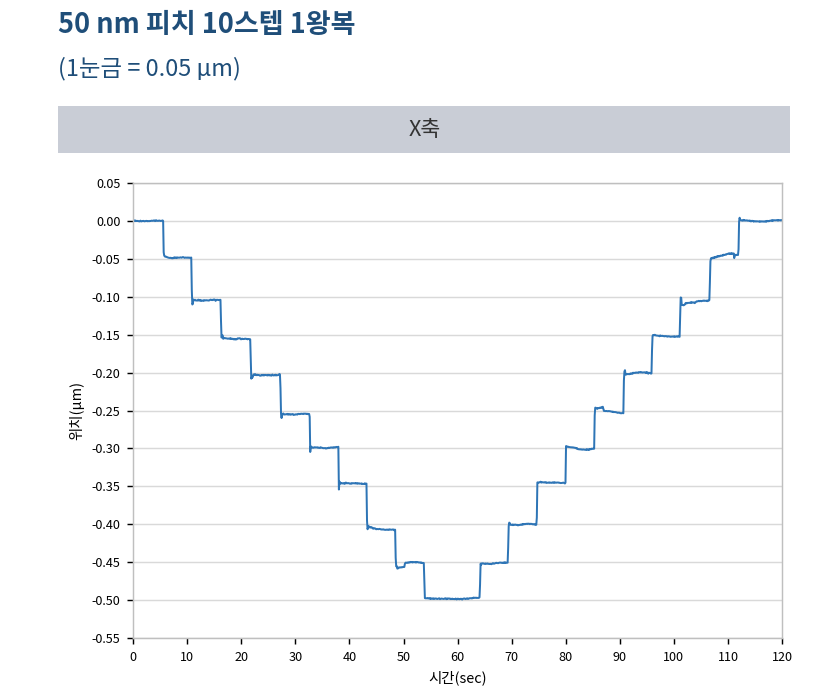
Verification: Renishaw XL-80 laser interferometer (25.7°C / 46% RH)
Immediate step response with no observed dead zone during the 10-step forward/reverse sequence
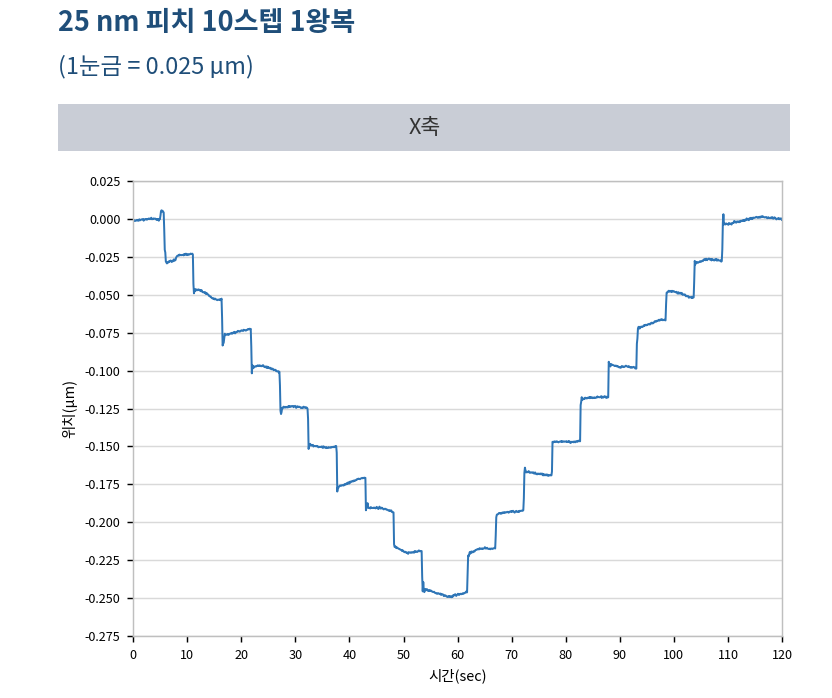
Verification: Renishaw XL-80 laser interferometer (25.6°C / 46% RH)
Accurate tracking and stable holding at single-count encoder increments, with no observed stick-slip
Nanometer-scale displacement measurements are sensitive to environmental disturbances. Testing was performed on a precision vibration-isolation table in a temperature- and humidity-controlled environment, with strict control of vibration, airflow, and temperature variation. Actual positioning performance may vary with operating conditions, including vibration, temperature, and load.
Key Specifications & Driver Configuration
| Control Algorithm |
Sinusoidal Vector Control (FOC + SVPWM) Cascaded Position, Velocity & Current Feedback Loops |
|---|---|
| Supported Motor Models | 2-Phase Stepper and BLDC Motor Models (select model to suit drive requirements) |
| Feedback & Thermal Control |
Up to 29-bit Absolute Encoder Load-Adaptive Current Control (Reduced Heating) |
| Communication & GUI |
EtherCAT (Up to 128 Synchronized Axes) + Local Setup Interface (CAN, USB, RS232) |
Application-specific configurations for single-axis nanopositioning, optical active alignment, 6-DOF parallel mechanisms, and synchronized control of up to 128 axes.

