
 Korean
- CompanyCompany
- TechnologyTechnology
- Motorized StageMotorized Stage
- Manual StageManual Stage
- Customer ServiceCustomer Service
- Arch-ServoArch-Servo
- SpecificationSpecification
- MaterialMaterial
- BearingBearing
- Drive SystemDrive System
- Motion ControlMotion Control

 home > Technology > Bearing
Bearing
A bearing is a core mechanical component that determines the load capacity and operational lifespan of a precision stage. An appropriate bearing must be selected based on the system's required precision and operating environment. It is positioned between two contact surfaces performing linear or rotary motion to minimize frictional resistance and induce smooth, precise movement.
Ball Bearing
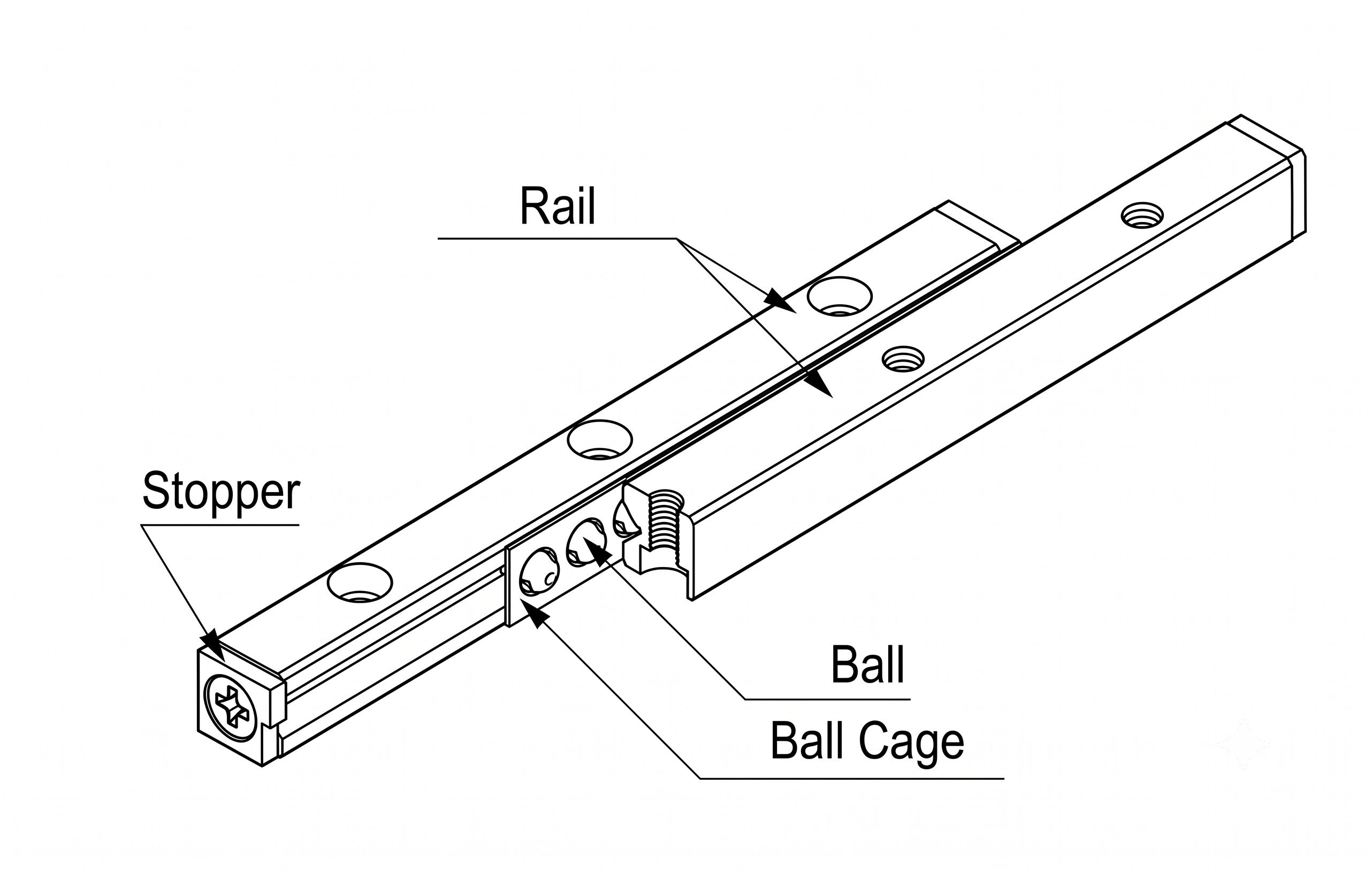
Steel balls perform rolling motion between precision-ground V-grooves or rods to reduce frictional resistance. Composed of a preloaded multi-row ball arrangement, the balls and rails form a 4-Point Contact, providing extremely low friction compared to other bearings, along with smooth operability and excellent precision.
Square Rail Bearing (LM Guide)
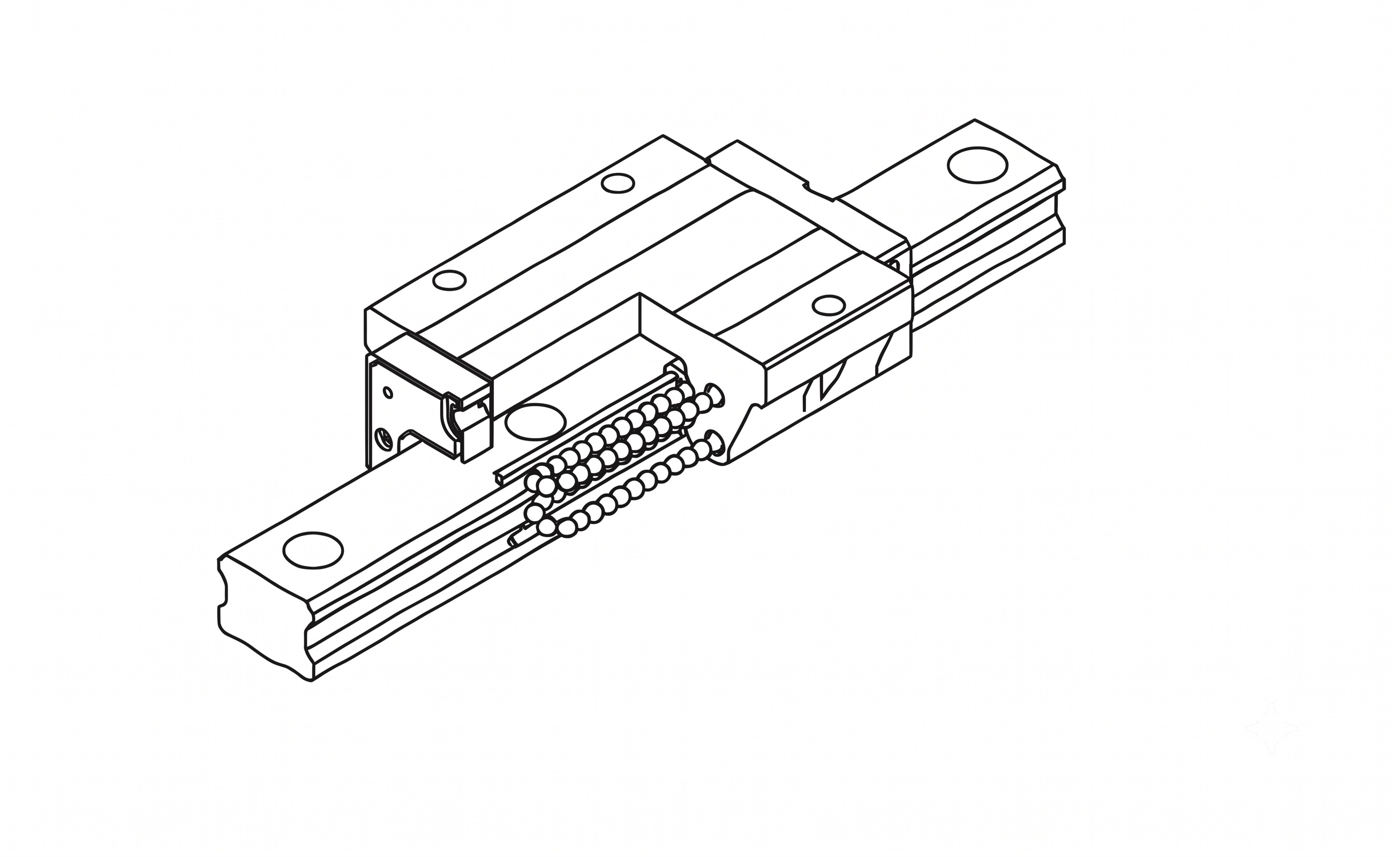
Generally referred to as an LM Guide in industrial fields, this is a recirculating type bearing. Multiple rows of balls or rollers circulate and drive inside a square rail and block. It has exceptional structural stability, allowing for long stroke applications, and provides outstanding omnidirectional load capacity and high rigidity.
Cross Roller Bearing
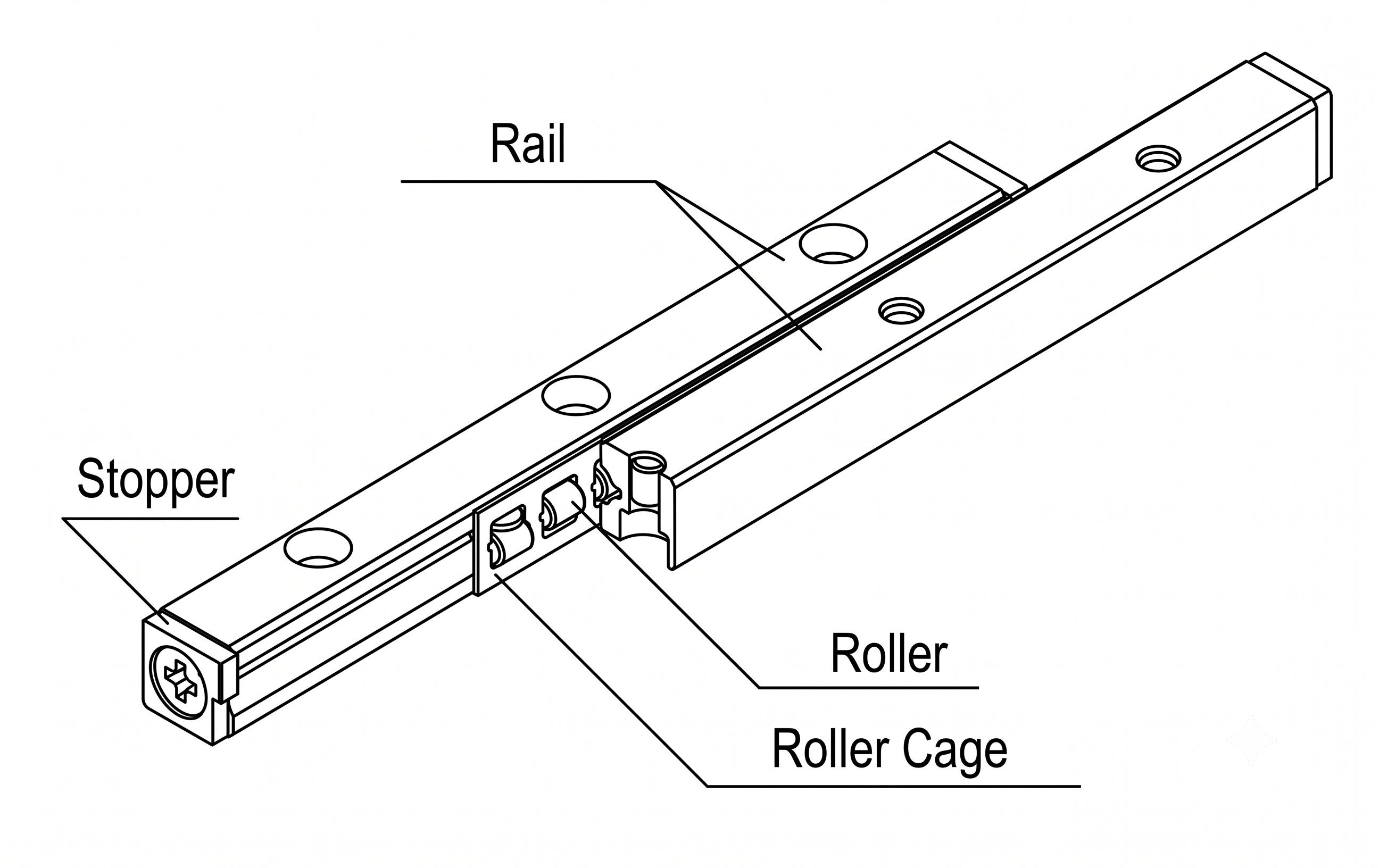
This bearing operates on a 90° V-groove rail by alternately assembling precision-ground cylindrical rollers at right angles within a roller cage. Unlike balls that make point contact, it utilizes a Line Contact structure to distribute loads widely. The rails are installed in parallel to support loads from all directions, and by applying preload to eliminate clearance, it provides an overwhelming load capacity and high rigidity that is 2-3 times greater than that of equivalent ball bearings.
Dovetail Guide
A type of plane bearing driven by sliding friction between precision-ground workpiece surfaces. Since the surfaces are in direct contact, it offers excellent damping against external vibrations and easy preload adjustment. However, due to frictional heat and wear on the sliding surfaces, there are limitations for long strokes or high-speed, frequent repetitive motions. Therefore, it is primarily applied to manual stages with short strokes where stability is required.
Round Rail Bearing
This is a recirculating linear motion bearing that combines cylindrical mechanical elements such as support rails, ball bushings, and pillow blocks. It operates using point-contact rolling friction between the balls assembled in the bush and a round shaft. It is widely used for general transfer purposes due to its easy assembly and low cost, but it is rarely used in ultra-precision stages because of its relatively low load capacity and moment rigidity.
Bearing Performance Comparison
| Attribute | Ball Bearing | Cross Roller Bearing | Square Rail Bearing | Dovetail | Round Rail Bearing |
|---|---|---|---|---|---|
| Max. Stroke | 600mm | 800mm | Free | Free | Free |
| Friction | ◎ | ○ | △ | △ | ○ |
| Smoothness | ◎ | ○ | △ | △ | △ |
| Straightness | ○ | ◎ | ○ | △ | △ |
| Flatness | ○ | ◎ | ○ | △ | △ |
| Load Capacity | △ | ○ | ◎ | ○ | ○ |

